

Why Surfacing Matters: New Research on Playground Playability
Independent research from The University of Texas at Austin’s Center for Research to Community Impact set out to answer a question playground designers rarely have hard data on: does the play surface on a playground actually change how kids play? Researchers observed play across multiple playgrounds, logging 60 structured observations and surveying 89 caregivers, comparing the three most common surfacing materials: engineered wood fiber, poured-in-place rubber, and synthetic turf. Rather than relying on assumption, the team built a defined, measurable concept of “playability,” scoring each surface on activity level, social interaction, inclusivity, and overall use.
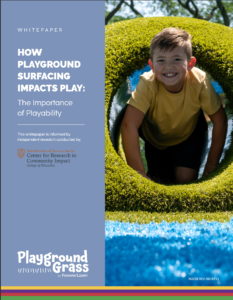
The results point in one direction. Synthetic turf consistently outperformed the other two surfaces across every playability measure, drawing more users, more active play, and more social play groups than engineered wood fiber or poured-in-place rubber. Turf-surfaced playgrounds saw an average of 12 users at a time and about 52% of kids engaged in active play, well ahead of both alternatives. That advantage held across income levels, and in lower-income neighborhoods the gap widened even further, with turf-surfaced playgrounds seeing dramatically higher use and engagement than their counterparts. Caregivers noticed the difference too, rating turf higher for comfort, cleanliness, safety, and accessibility for kids of different abilities. For architects, planners, and municipalities weighing surfacing options, the findings offer something rare: real, measurable evidence of how playground surfacing shapes the way a community actually plays.
Download the FREE White Paper
Complete the form to access a free download of our white paper discussing how playground surfacing impacts play.